Quietly Crafted. Deeply Felt.
Quietly Crafted. Deeply Felt.

Blog Detail
24/08/2026 | 15 Min Read
How Do NRIs Approve Design Decisions on a Gurgaon Project Without Visiting the Site?
NRIs approve design decisions remotely through a structured combination of photorealistic 3D visualisation, scheduled video walkthroughs, milestone-based sign-offs, and digital documentation, all sequenced so that every major decision is made and approved before execution reaches that stage on site.

Done properly, an NRI client can oversee a full villa or penthouse interior project in Gurgaon from London, Dubai, or New York and never need to step onto the site until the final handover, sometimes not even then.
This isn't a workaround or a compromise version of the process, it's arguably a better one, because it forces a level of upfront planning and documentation that in-person projects sometimes skip. When you can't rely on the client walking the site every other week to catch issues visually, the entire workflow has to be designed to surface decisions clearly and early, on screen, before they become physical, expensive, and harder to undo.
The Approval Sequence, Step by Step
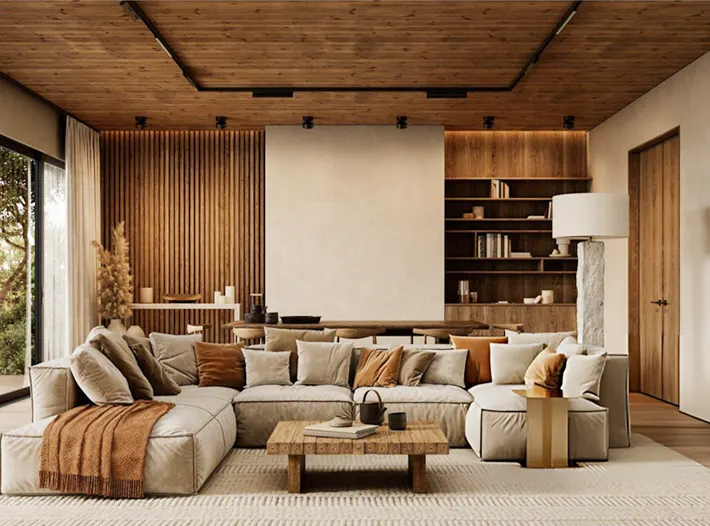
It starts with a detailed brief, usually gathered over video calls, covering how the client actually plans to use the home, whether it's a primary residence for visits, a long-term investment, or eventually a base for family in India. From there, space planning and material palettes are presented digitally, followed by full 3D visualisation of every room, photorealistic enough that the client can judge how a stone floor, a joinery finish, or a lighting scheme will actually look and feel, not just guess from a sample swatch.
This is the single most important part of remote approval. A flat 2D floor plan asks a client to imagine a space; a 3D render or walkthrough shows them the space. For someone approving a ₹1 crore-plus villa interior from another continent, that difference is what makes confident decision-making possible without a site visit. commercial interior designer Once the client approves the 3D visualisation room by room, that becomes the locked reference for execution, paired with a fixed BOQ under a Zero Escalation Policy so there's no ambiguity about what's being built or what it costs.
Milestone-Based Sign-Offs During Execution
Rather than the client trying to track daily progress, a well-run remote project is structured around clear milestones, civil and electrical completion, flooring and stone work, joinery installation, final finishing and styling. At each milestone, the client receives photo and video documentation and a scheduled video call to review progress against the approved 3D visualisation, and gives sign-off before the project moves to the next stage. This keeps the client genuinely in control of major decisions without needing to be physically present or constantly available.
Native Sutra's process is built around exactly this kind of structured, milestone-based workflow, which is also why full home projects can be delivered within 45 days of execution starting, decisions aren't being made or revisited on the fly, they're locked at each checkpoint and executed against.


Handling Payments, Approvals, and Legal Steps Remotely
Beyond design decisions, NRI clients also need to handle payments and formal approvals from abroad, and this is usually managed through digital payment channels tied to NRE or NRO accounts, along with a Power of Attorney arrangement if a family member or representative needs to handle any physical tasks like receiving deliveries or being present for inspections that genuinely require someone on-site. It's worth setting this up early in the process rather than scrambling for it once execution has already begun.
What Can Go Wrong Without the Right Process
Remote approval works well when the process is disciplined, but it can go badly wrong without it. The most common failure is vague or infrequent updates, a WhatsApp photo here and there isn't a substitute for structured milestone documentation, and it leaves too much room for the client to feel out of the loop or discover a problem too late to fix cheaply. Another common issue is designers who skip proper 3D visualisation and rely on verbal descriptions or rough sketches, which almost guarantees a "this isn't what I expected" moment once the client eventually does see the space in person. corporate interior designers in gurgaon And without a locked BOQ, cost conversations can get messy fast when there's no one physically present to negotiate or push back on-site.
Time Zone Planning Matters More Than People Expect
A detail that's easy to overlook: scheduled video calls need to actually work across time zones, which usually means the design team building in flexibility for early morning or late evening India time to match business hours in the US, UK, or Gulf. A firm that only offers calls during standard Indian working hours isn't really built for NRI clients, no matter what their marketing says.
Why This Matters for Gurgaon's NRI Investment Market Specifically
Gurgaon has become one of the most active markets in India for NRI real estate investment, particularly in premium developments along Golf Course Road, Golf Course Extension Road, and DLF's high-end projects. Native Sutra Many of these owners aren't planning to live in the home full-time immediately, which makes a genuinely remote-friendly interior process essential rather than optional. It's also why property management services for NRI and outstation owners have become a natural extension for design firms working in this segment, someone needs to be the eyes and hands on the ground between visits, and that continuity matters as much after handover as it does during execution.
For NRIs choosing a luxury interior designer in Gurgaon, the real question to ask isn't whether remote approval is possible, most firms will say yes. It's whether their process is actually built around it, with 3D visualisation, milestone documentation, and fixed pricing that removes the need for a client to be physically present to protect their own interests.