
Quietly Crafted. Deeply Felt.
Quietly Crafted. Deeply Felt.

Blog Detail
Explore minimalist interior design ideas curated by the best interior designers in Gurgaon. This blog shares expert tips on colour palettes, smart storage, lighting, and texture to create calm, clutter-free homes. Discover how a leading interior design company in Gurgaon like Native Sutra transforms modern spaces with warm, functional minimalism.
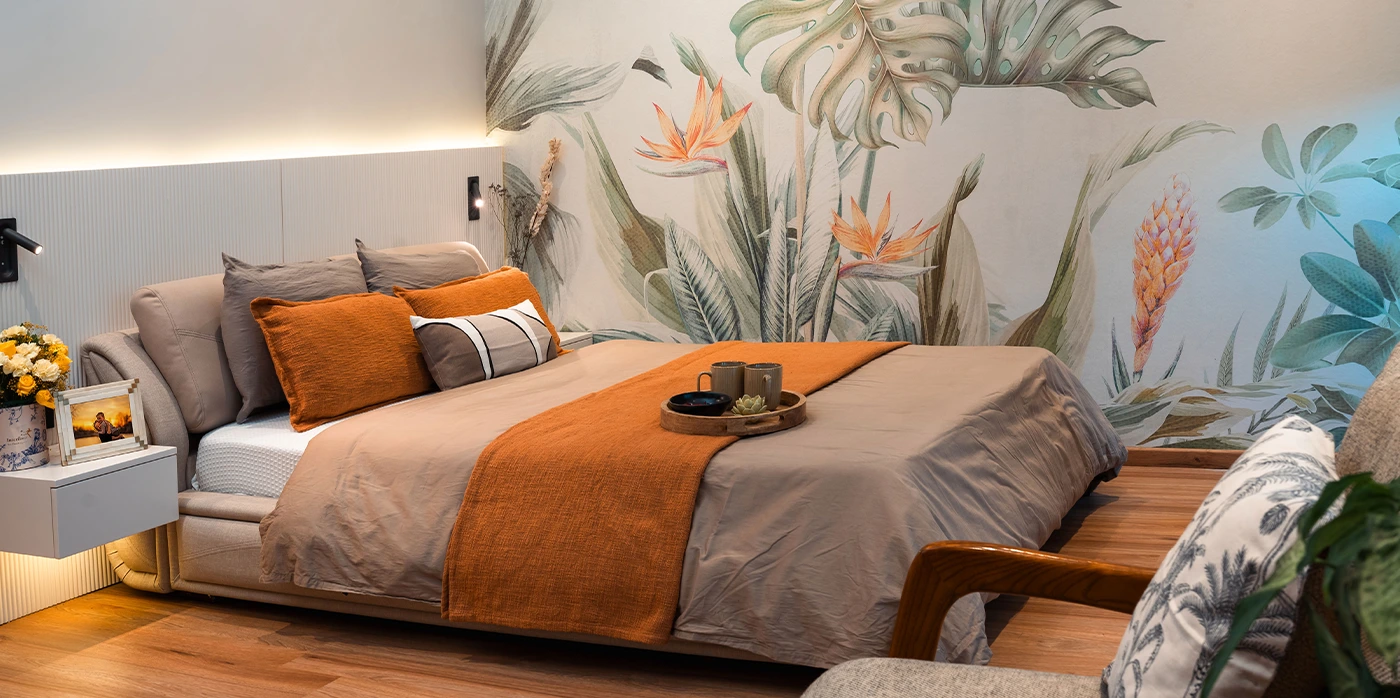
Somewhere between the fourth store visit and the tenth catalogue scroll, most people trying to redesign their home arrive at the same quiet conclusion: they want less, not more.
Less visual noise. Less stuff competing for attention. Less of that uneasy feeling that the house hasn't quite come together yet. What they're describing, even if they don't call it this, is minimalism. And the version they're picturing isn't a cold, bare apartment with one white chair. It's warmer, more intentional, more human than that.
Minimalist interior design, done well, is one of the hardest styles to execute precisely because it has no excess to hide behind. Every single element carries more weight: the proportion of the sofa, the tone of the wall, the way afternoon light falls across the floor. Getting it right requires both a strong design sensibility and a real understanding of how the person who lives there actually spends their day.
Here are the interior design ideas that Gurgaon's most thoughtful designers keep coming back to, and why they work better than most people expect.
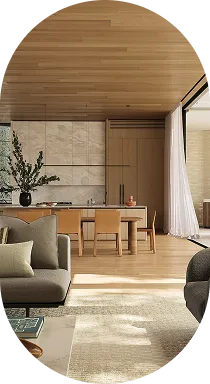
Gurgaon's premium apartments, in Ireo Gurgaon Hills, Tatvam Villas, and M3M Golf Estate, tend to share certain qualities: open-plan layouts, floor-to-ceiling windows, high ceilings, and generous natural light. These are precisely the conditions under which minimalist design performs best.
A cluttered interior with too many competing finishes actively fights against a beautiful open-plan space. The light has nowhere to settle. The eye has nowhere to rest. The architecture gets buried under accumulated things.
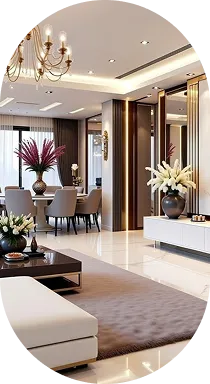
Minimalism in these settings doesn't mean emptiness. It means every piece earns its place through purpose, proportion, or beauty, ideally all three. The architecture gets to speak, and the design choices within it feel deliberate rather than collected.
The most common mistake in minimalist interiors isn't the wrong furniture. It’s too many colours.
A minimalist palette isn't all-white everything. It's one dominant tone running through the entire space, layered with one or two close variations and a single contrasting accent. Warm stone with ivory and raw linen. Muted sage with warm grey and natural oak. Charcoal with cream and matte black hardware.
When the palette is tight, the eye experiences the space as cohesive and calm rather than busy. This is what creates the feeling people describe as "put-together" in interiors they admire — it's almost never about expensive materials, it's about colour discipline.
For Gurgaon homes with abundant natural light, warm neutrals work particularly well. They shift subtly through the day as light changes, giving a minimalist room a quality of aliveness that stark white walls can't replicate.
Minimalist rooms that feel interesting always have a focal point, one element that carries most of the visual weight while everything else stays quiet around it.
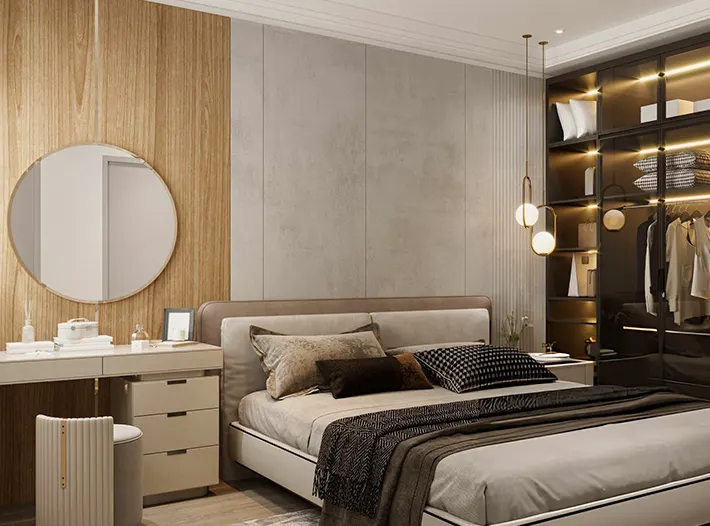
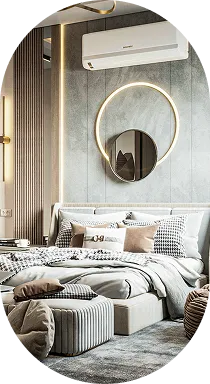
In a living room, this might be a sofa in an unusual silhouette, or a low sideboard in richly grained wood, or a single large-format artwork positioned with precision. In a bedroom, the headboard takes this role, wide, upholstered, authoritative against a restrained wall.
The interior design idea here is simple but hard to execute in practice: resist the impulse to add. Once the statement piece is in, ask what else the room actually needs, not what else you'd like, and keep that list very short. Minimalism is editing as much as it is selecting.
Nothing defeats minimalist intent faster than visible storage. The moment a bookshelf, a shoe rack, or an open wardrobe becomes visible, the eye starts inventorying things rather than experiencing the space.
The solution is integrated storage that disappears into the architecture: floor-to-ceiling wardrobes with handle-free push-to-open doors, built-in shelving behind panel doors that blend flush with the wall, a console that conceals the tangle of cables and chargers behind a clean face.
This is where working with a skilled interior design company in Gurgaon earns its cost. Designing invisible storage requires spatial planning from the outset. The junction between a wall panel and a ceiling, the depth of a wardrobe that allows a room to keep its proportions, these decisions happen at the design stage or they don't happen well at all.
The reason many minimalist interiors feel cold isn't the palette or furniture. It's the absence of texture. When every surface is smooth, polished stone, painted walls, lacquered furniture, the brain reads the space as clinical rather than calm.
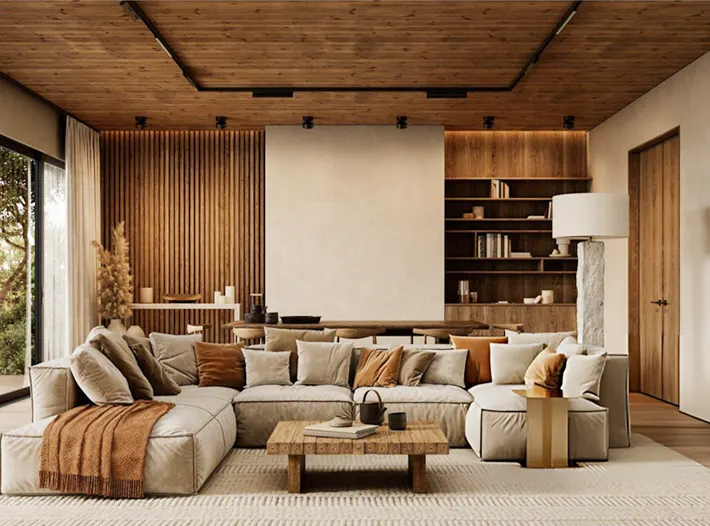
The fix is texture through materials that read as quiet but feel rich: a jute rug with a geometric weave, a bouclé armchair in off-white, linen curtains with a slight irregular grain, and a teak side table with a matte oil finish. None of these adds visual complexity, but they change the emotional temperature of a room profoundly.
Minimalism and natural light have a symbiotic relationship. Clean, uncluttered spaces allow light to behave as a design element, moving across walls, catching the grain of a wood surface, and creating depth through shadow in the afternoon.
Practical implications: window treatments should diffuse rather than block daylight. Furniture shouldn't sit in front of windows. A large mirror, a glass vase, or a polished stone surface should be positioned to amplify natural light, not compete with it.
In the evenings, the same thinking applies to artificial light. Multiple warm-toned, dimmable sources at different heights allow a minimalist interior to shift from daytime clarity to evening softness, without introducing any visual clutter.
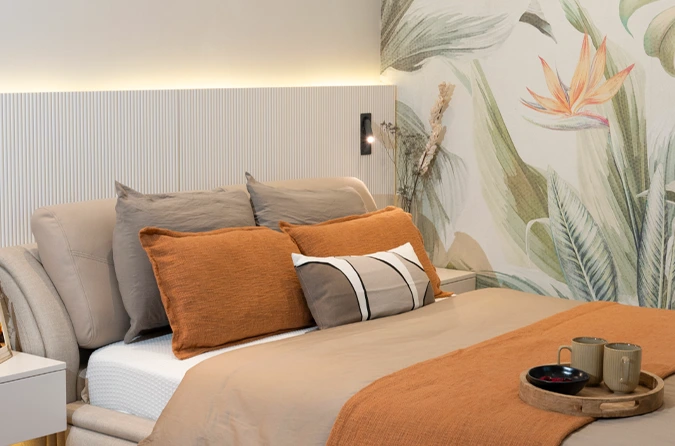
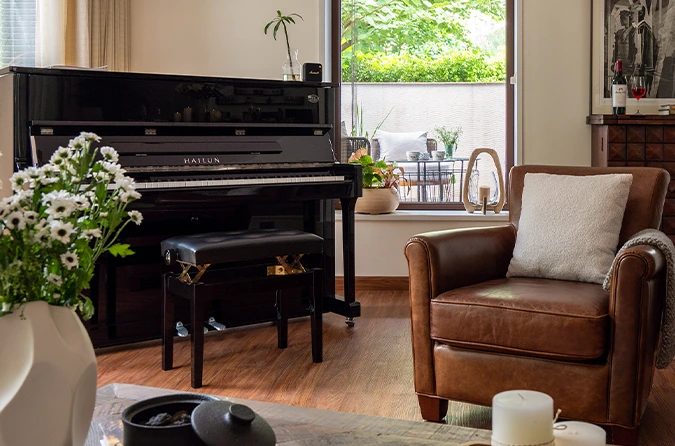
Understanding minimalist principles is one thing. Applying them in a real home, for a real family, on a real timeline, is another.
Native Sutra's portfolio shows what this looks like in practice. At Ireo Gurgaon Hills, the design team worked with a large-format apartment where the brief was to bring calm without making the space feel underdesigned. The solution centred on a restrained warm-neutral palette, integrated joinery running wall-to-wall, and textile layering that added sensory richness without visual fragmentation.
Villa Tranquility, a 4,750 sq ft residence at Tatvam Villas in Gurugram, presented a different challenge: merging contemporary minimalist architecture with a setting defined by nature. Parul and Vineet Agarwal's approach for this project kept the interior palette deliberately understated, allowing the surrounding landscape to function as the visual anchor.
The Fusion House project at Tatvam Villas took a related approach, pairing linen, ikat, and cotton upholstery with clean-lined furniture and polished marble, creating a minimalist base that carried genuine warmth through material choice alone. Native Sutra's name for this, "Contemporary Indian Chic" captures something real: minimalism rooted in local material heritage rather than imported aesthetic codes.
What runs through all three projects is the same discipline: a willingness to make fewer choices so that each one has more power.
Minimalism is not about living with less. It's about making room for what matters. If you're ready to design a home in Gurgaon or Delhi NCR that feels calm, considered, and genuinely yours, Native Sutra is ready to help.
Book a consultation with the Native Sutra team, and take the first step toward a home built around how you actually live.
Q: Is minimalist design suitable for families with young children and pets?
Yes — and in many ways, more practical. Integrated storage reduces surfaces for clutter to accumulate on, and durable fabric choices like performance linen clean easily. Minimalism works for families when it's designed around how they actually live.
Q: How do I make a minimalist home feel personal, not showroom-like?
A few meaningful objects — art you love, a plant in a well-chosen pot, a single photograph — carry far more emotional weight in a restrained space than they would in a busy one. The key is choosing them carefully and giving each one room to breathe.
Q: Does minimalism mean giving up storage?
The opposite. Good minimalist design prioritises storage — it just designs it to be invisible through built-ins, integrated joinery, and flush-panel wardrobes.
Q: Can Native Sutra work on a single room rather than the whole home?
Yes. Many clients start with one room and expand the project once they've seen the results. Native Sutra works across all project sizes.